Fitting IAS 19 into the Actuarial Control Cycle
Managing employee benefits under IAS 19 is rarely just a calculation exercise. It is a balancing act between two corporate forces. On one side, Finance wants to keep the Defined Benefit Obligation (DBO) low and predictable to protect the balance sheet from volatility. On the other side, HR needs realistic assumptions that match actual salary inflation so compensation remains competitive.
Actuaries manage this tension using the Actuarial Control Cycle. This simple three-step feedback loop—specifying the problem, designing the solution, and monitoring the results—keeps valuations grounded in corporate reality.
Analyzing the economic environment
Before setting assumptions, you have to look at the macroeconomic and regulatory environment. For IAS 19, this means tracking inflation and corporate bond yields.
Inflation directly pressures salary growth rates, while bond yields dictate the discount rate. When yields shift, the liability size swings with them, regardless of how well the business is doing.
Many companies rely on external industry benchmarks rather than analyzing their own historical census data. It is a common shortcut, but it introduces basis risk. IAS 19 requires financial assumptions to be entity-specific. If you use industry averages blindly, you risk auditor pushback. For instance, if competitors start poaching your staff and forcing salary hikes, your actual compensation costs will quickly outpace general industry benchmarks.
Balancing stakeholders and ethics
The actuary often sits directly between Finance and HR. Finance will push for lower salary growth assumptions to suppress the DBO and minimize P&L swings. HR will advocate for higher assumptions to reflect recruiting realities. The actuary’s job is to stay objective and ensure assumptions are unbiased and mutually compatible.
We also have a duty to auditors and regulators. That means resisting pressure to cherry-pick favorable benchmarks, and documenting exactly why a benchmark is a realistic proxy for the company's demographic profile.
The risks of relying on benchmarks
Relying too heavily on industry benchmarks to set and monitor assumptions introduces several specific risks:
First, internal salary inflation can easily outstrip the benchmark. If your company has aggressive promotional paths or union agreements, using a generic average will lead to an understated DBO.
Second, benchmarks hide the unique characteristics of your workforce. An industry average filters out crucial details, like whether your staff is young and advancing quickly or mature and stable.
Third, discount rate volatility complicates the model. If credit spreads compress, liabilities expand. If your salary growth assumptions are already underestimated, this compression compounds the balance sheet shock.
Closing the feedback loop
Relying on external benchmarks for monitoring breaks a fundamental rule: the feedback loop must reflect your actual experience.
The loop should look like this:
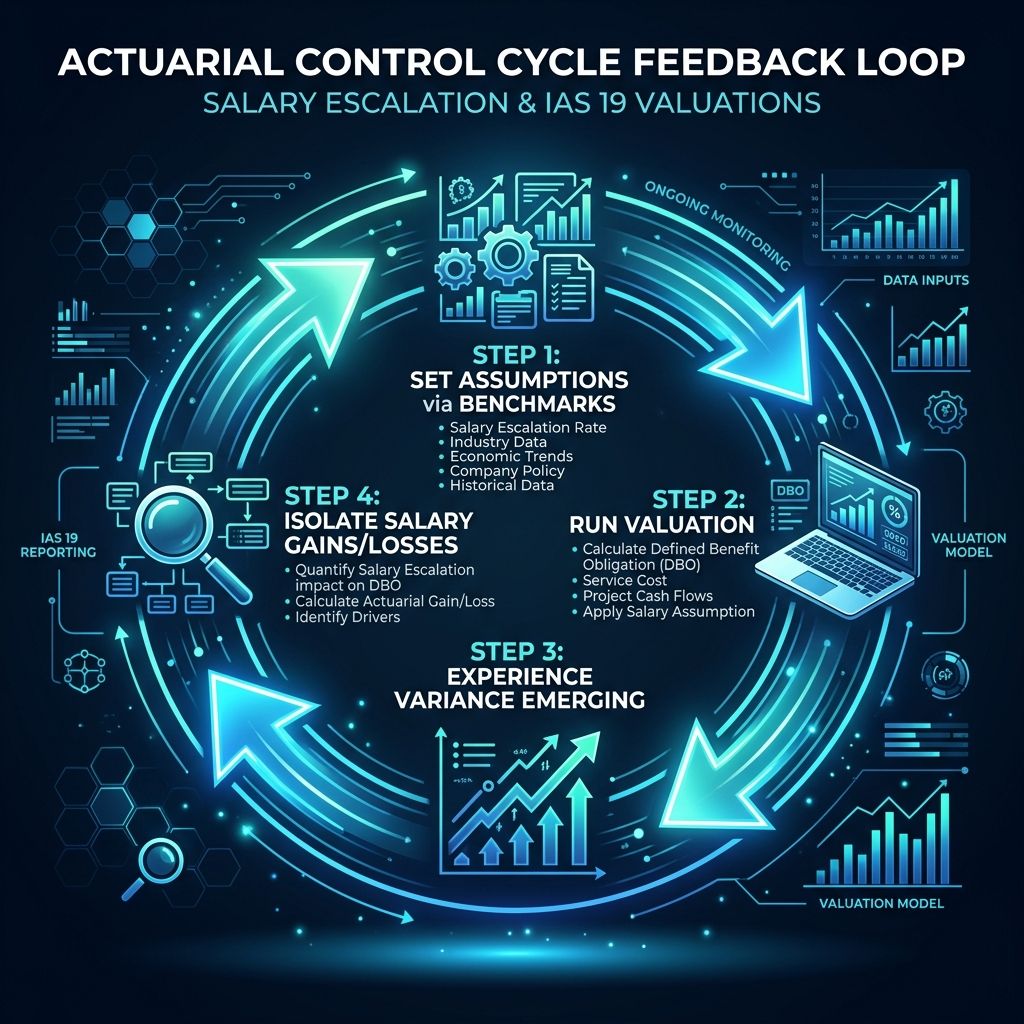
Every year, you should run an experience analysis to compare assumptions against what actually happened. By isolating the actuarial gains and losses driven specifically by salary changes, you can see if your model is drifting.
If the analysis shows consistent actuarial losses because actual salary hikes were higher than the benchmarks, you must adjust the assumption upward for the next cycle. This keeps the model realistic, protecting Finance from year-end balance sheet surprises while keeping HR aligned.
Need Help With Your IAS 19 Valuation?
Our qualified actuaries can help you with discount rate selection, assumption setting, and full IAS 19 valuations.
Get a Quote